A fishing light that screams like a jellyfish under attack
Deeplight is a stick of clear epoxy with 32 blue LEDs inside. It hangs on the line above the bait, 200 to 300 metres down in Norwegian fjords, and plays light patterns copied from real deep-sea animals, timed frame by frame from research footage.
The stick on the left runs the real Alarm pattern, with the same code as the light. Tap it: that is what happens when you jig.
Want one? Email Simen50 m
Down there, light is how things talk
Below about 200 metres there is almost no daylight left in a fjord. Most animals that live there make their own light: to hide, to hunt, to warn, to call for help. The fish and squid down there watch for it.
In 2004 Peter Herring and Edith Widder described how the deep-sea jellyfish Atolla wyvillei lights up when something grabs it: blue waves that race round its bell. The idea is that this burglar alarm calls in a bigger predator to eat the attacker, so the jellyfish can get away.
Widder then built an electronic copy, the e-jelly: 16 blue LEDs in a ring, cast in epoxy. Squid came to it again and again, and in 2012, off Japan, it helped bring a live giant squid in front of a camera for the first time.
Deeplight takes the same idea fishing. Nobody has tested which light pattern works best on a fishing line, or whether the fish in a Norwegian fjord care. That is the experiment.
Read more: Herring & Widder 2004, Widder 2007, “Sly eye for the shy guy”, Robinson et al. 2021, and the Ocean Research & Conservation Association (ORCA).
100 m
Copied from real animals
Each pattern below runs live with the same code as the stick. Each one copies an animal that makes light at fishing depth, and links to the people who studied it. Real displays rest in the dark for up to a minute between bursts; here the dark is skipped.
-
Atolla wyvillei
Alarm jellyfish, from about 500 m down, worldwide. Pattern: Alarm
The light starts at one point and spreads both ways round the bell. Then one wave circles for about 22 seconds: it speeds up to almost a full turn a second, slows to a third of that, and is brightest after 14 seconds. A dim tail, then dark until a minute has passed. This is the display Widder’s e-jelly was built to copy.
After Herring & Widder 2004, timed from NOAA’s 2005 footage.
-
Nanomia
A siphonophore: a colony of jellyfish relatives strung along a stem. The one in the film is about as long as the stick. Pattern: Nanomia
From a touch, separate points light up along the whole stick within half a second. Each one flares now and then and fades. Fully lit for about four seconds, half after eight, dark after twelve. In 2018 Nanomia cara was found in huge numbers near the bottom at about 320 m in the Lyngen fjords in northern Norway: the depth we fish at.
After the 1997 film by Tammy Frank, Edith Widder and Steve Haddock (UCSB Bioluminescence Web Page), Bassot et al. 1978 and Knutsen et al. 2018.
-
Periphylla periphylla
Helmet jellyfish (kronemanet), the local relative of Atolla. Pattern: Periphylla
Waves of light run both ways from where it was touched, then sparkles, then glowing particles that fade slowly. It lives in Norwegian fjords; half of the helmet jellyfish filmed for the 2004 study came from Lurefjorden, north of Bergen.
After Herring & Widder 2004 and Animal Diversity Web.
-
Meganyctiphanes norvegica
Northern krill (storkrill). Pattern: Krill
Many faint, short twinkles, like a swarm. Krill carry their own lights, and of all the glowing animals they turn up in the diets of the most deep-water fish, from tusk and haddock to squid. That makes them the obvious thing to imitate.
After Northern krill (Wikipedia).
-
Maurolicus muelleri
Pearlside (laksesild), 0 to 300 m. Pattern: Pearlside
Rows of steady, very faint dots that drift slowly, with a dropout now and then when a fish turns. Pearlside carry rows of light organs on their bellies and are a main food of the flying squid (akkar).
After photophores of pearlside in Masfjorden and Fensfjorden (University of Bergen, 2023).
The stick also has Startle (dark, then one sharp burst), Glow, Comet and Pinwheel for experiments.
150 m
How the Alarm got its timing
The papers describe the display in words and a few numbers. To copy it properly, it had to be measured. NOAA Ocean Explorer’s 2005 Deep Scope clip, filmed by Edith Widder, shows a captured Atolla doing the whole display in the dark.
In every frame the centre of the bell was found, the ring was cut into 72 slices, and the light was followed round it, 15 times a second for 29 seconds.
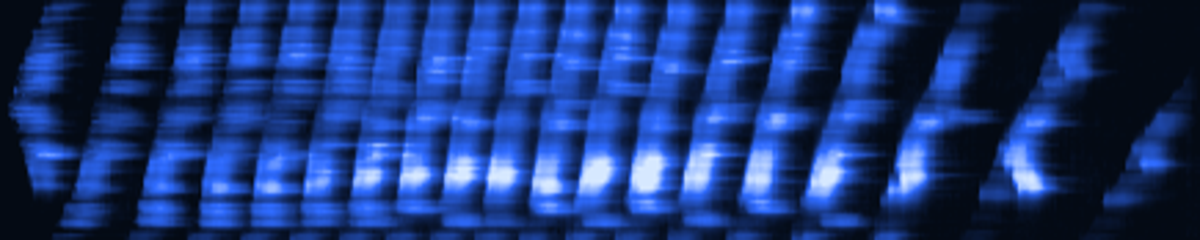
- 0.67turns per second on average
- 22 sof one wave circling the same way
- 14 suntil the brightest moment
- 1 mincycle, as Widder’s e-jelly ran
Footage: NOAA Ocean Explorer, Operation Deep Scope 2005, video courtesy of E. Widder (archived page). The measurements and charts here are ours.
200 m
From a board to a solid stick
The board
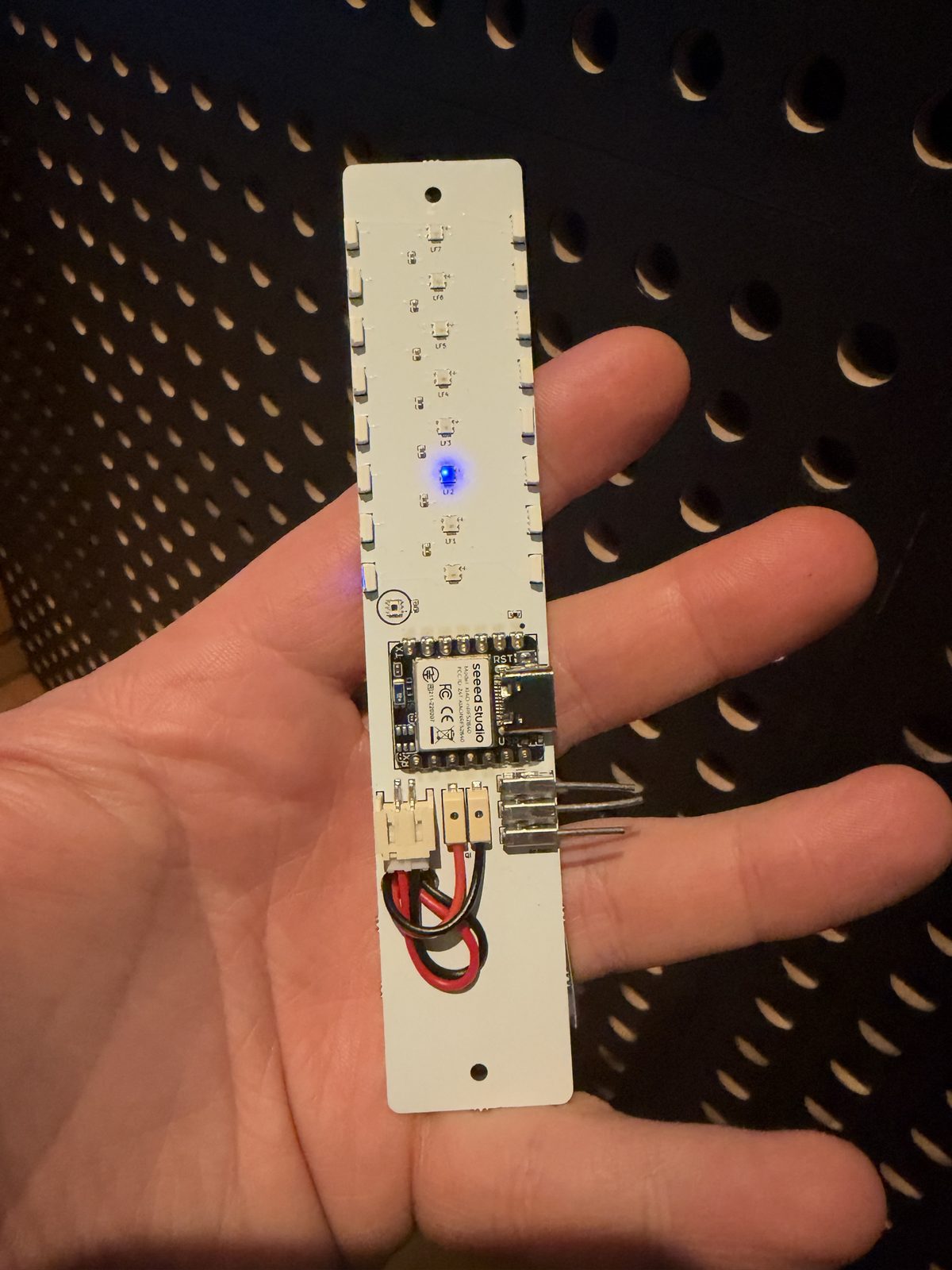
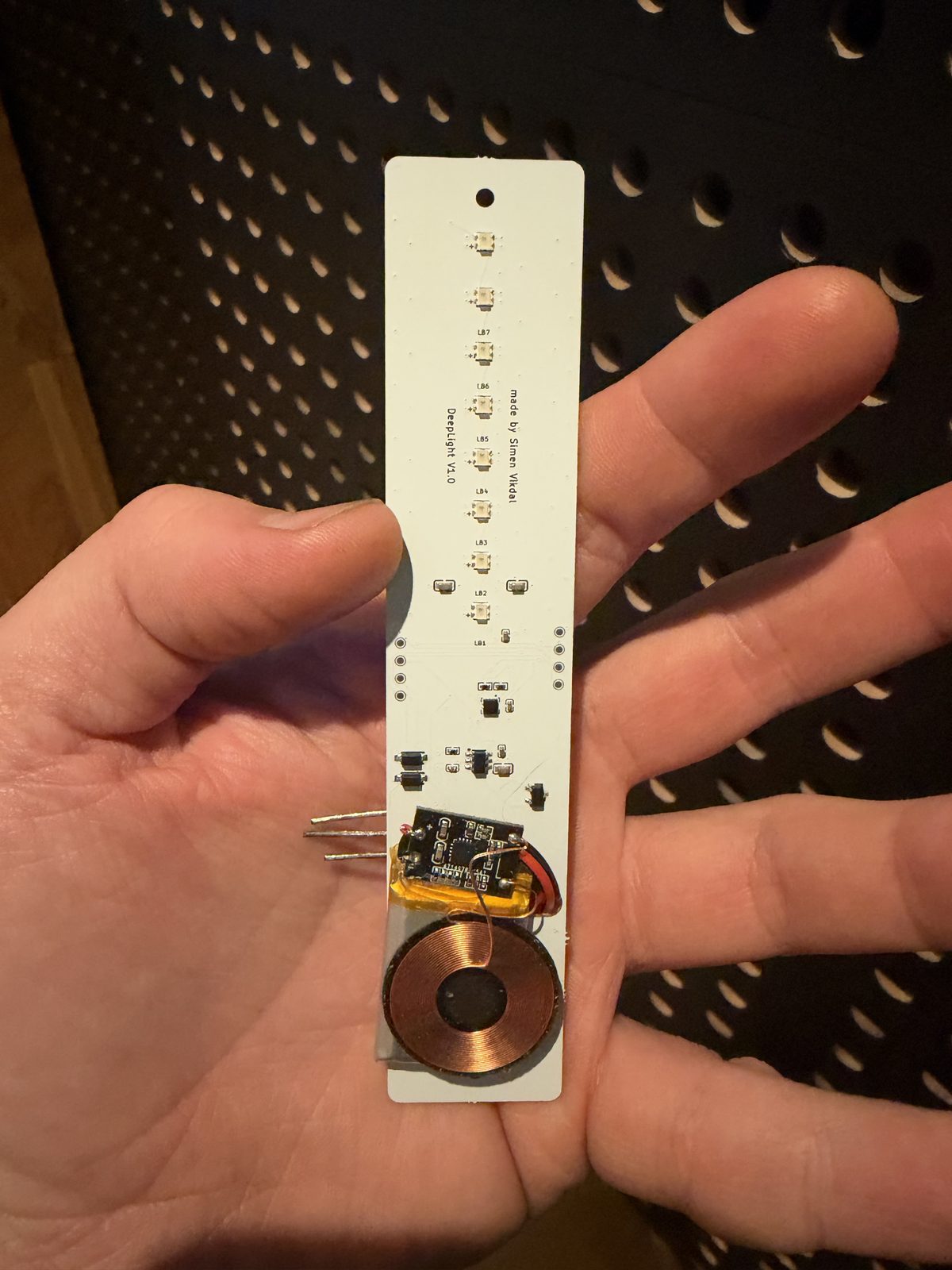
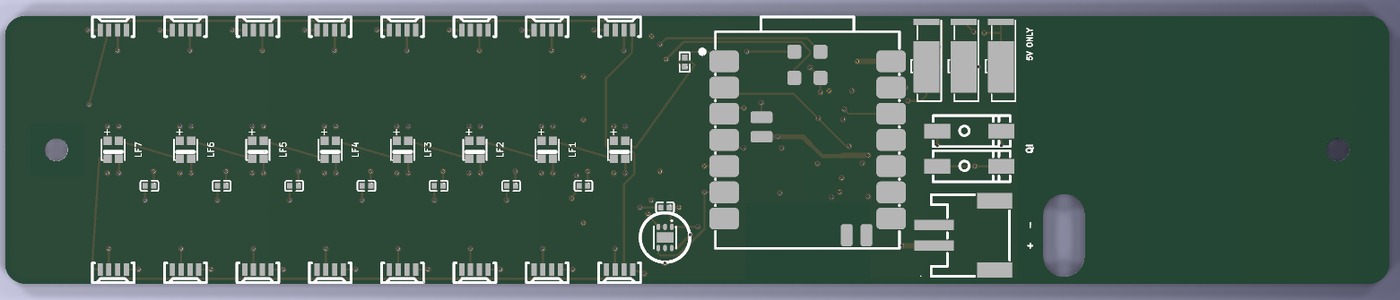
A 134 × 26 mm circuit board with eight light positions. Each position has four LEDs: one on the front, one on the back and a side-emitting one on each edge, so the light shows from every side. A small Bluetooth microcontroller runs it, with a motion sensor and a light sensor on the board. On the back: a 250 mAh battery and a wireless charging coil.
Cast solid, nothing inside to leak
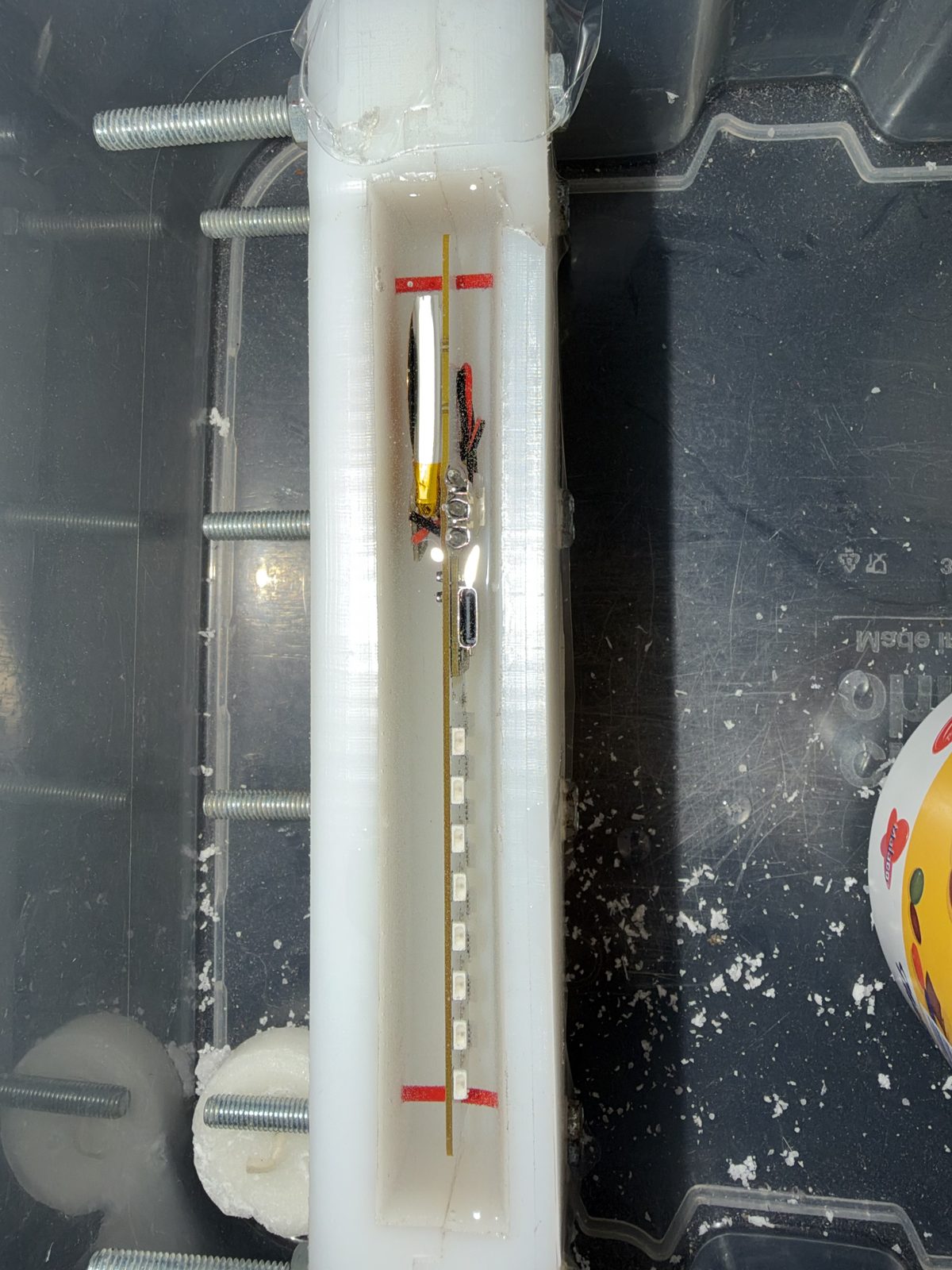
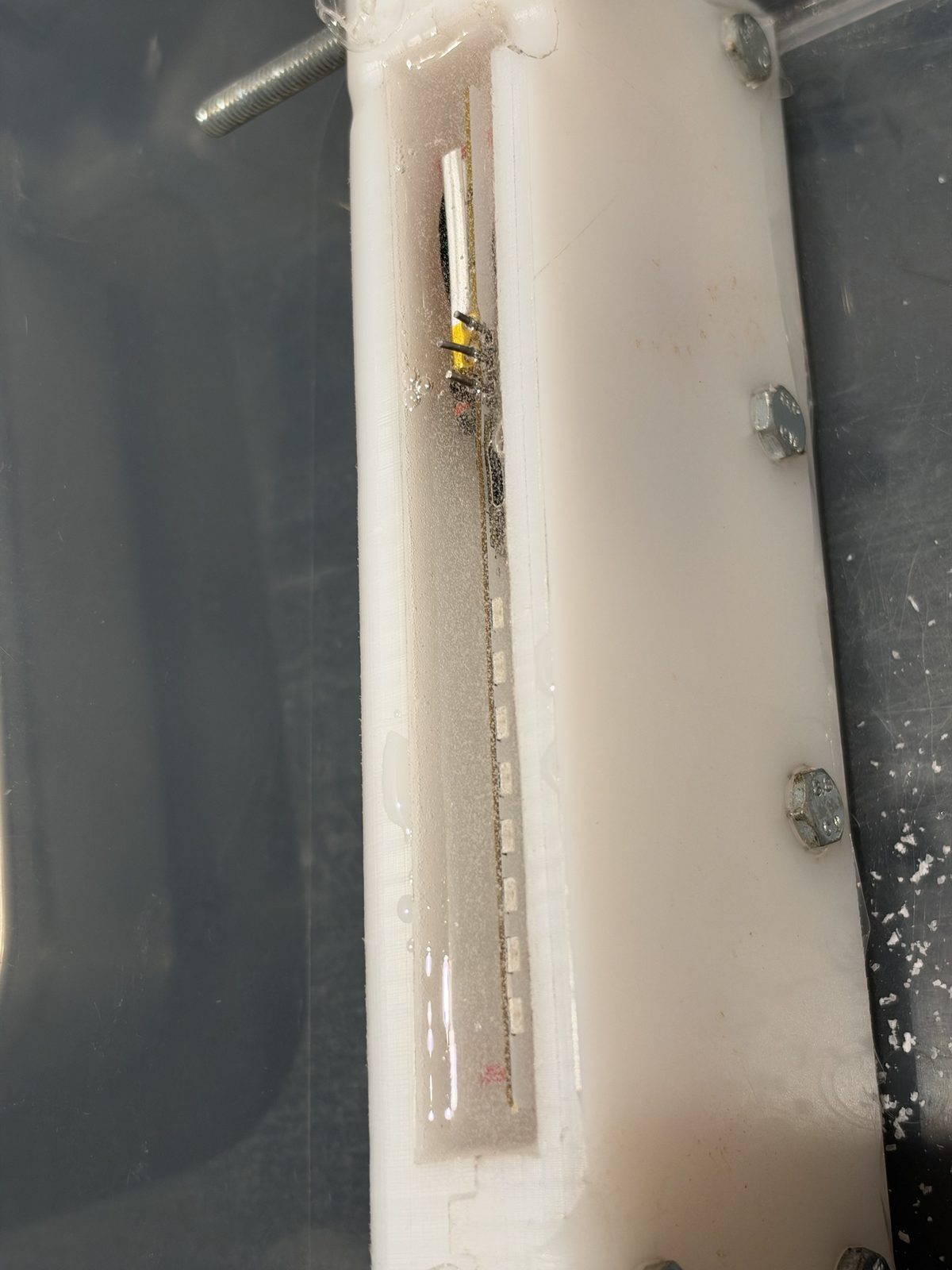
The whole board is cast into clear epoxy, about 146 × 33 mm. No seals, no screws, no air. Three titanium pins stick out: seawater between them switches the light on, and they double as a backup charging contact. Charging is meant to be wireless, straight through the epoxy; that is one of the next tests.
The mould
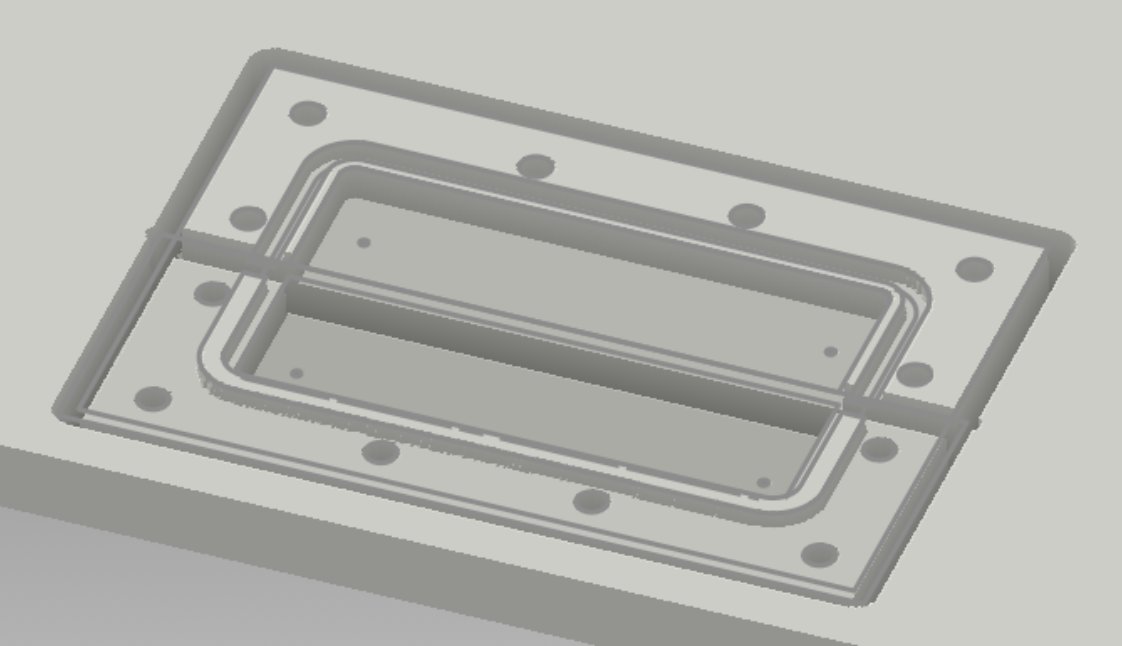
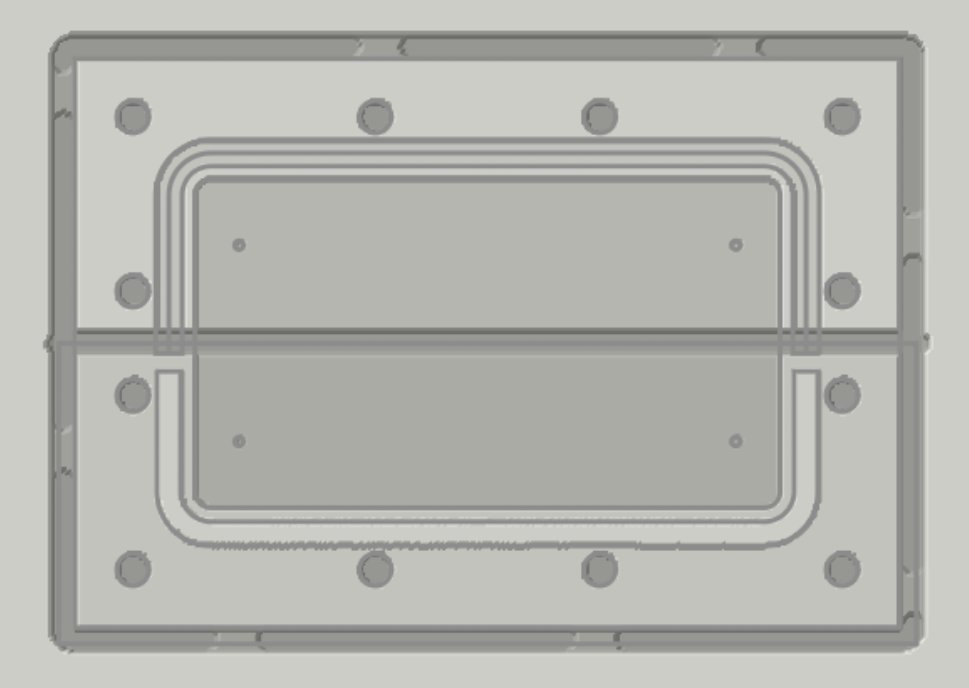
Cut on the CNC from 20 mm white HDPE, which epoxy does not stick to. Two halves bolt together with the board standing on edge in the cavity between them, held by two pins through its line holes.
Casting
Clear epoxy, 77 g resin to 33 g fast hardener for one stick. Poured into the closed mould, left to cure in a box. The first stick was cast on 18 November 2026.
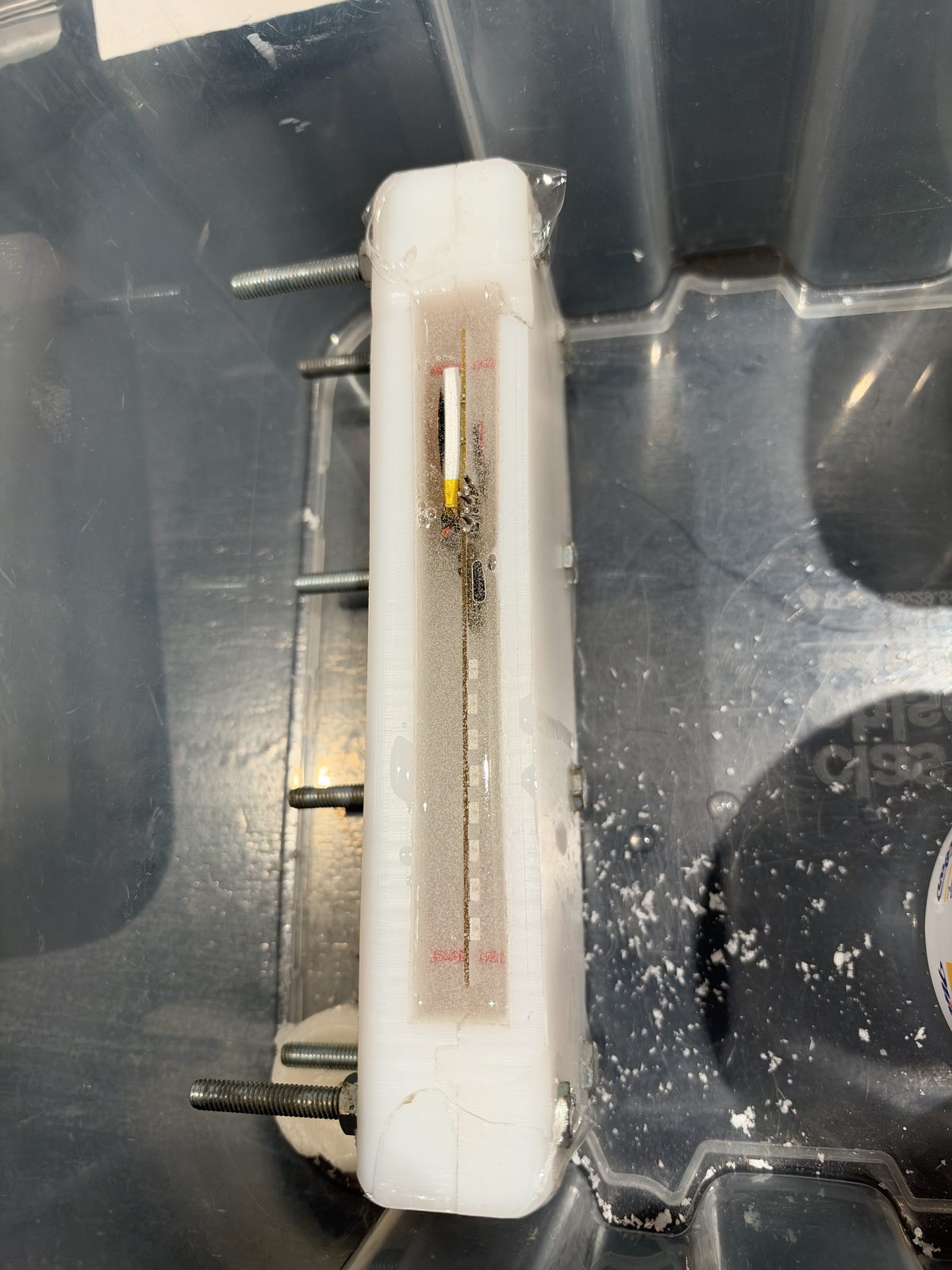
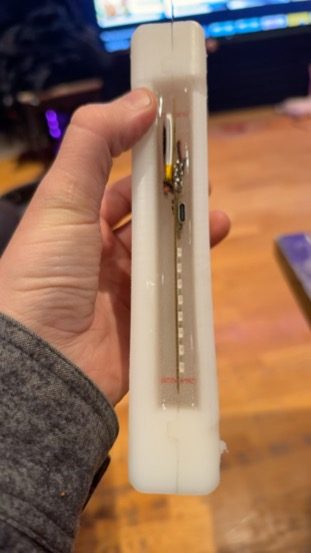
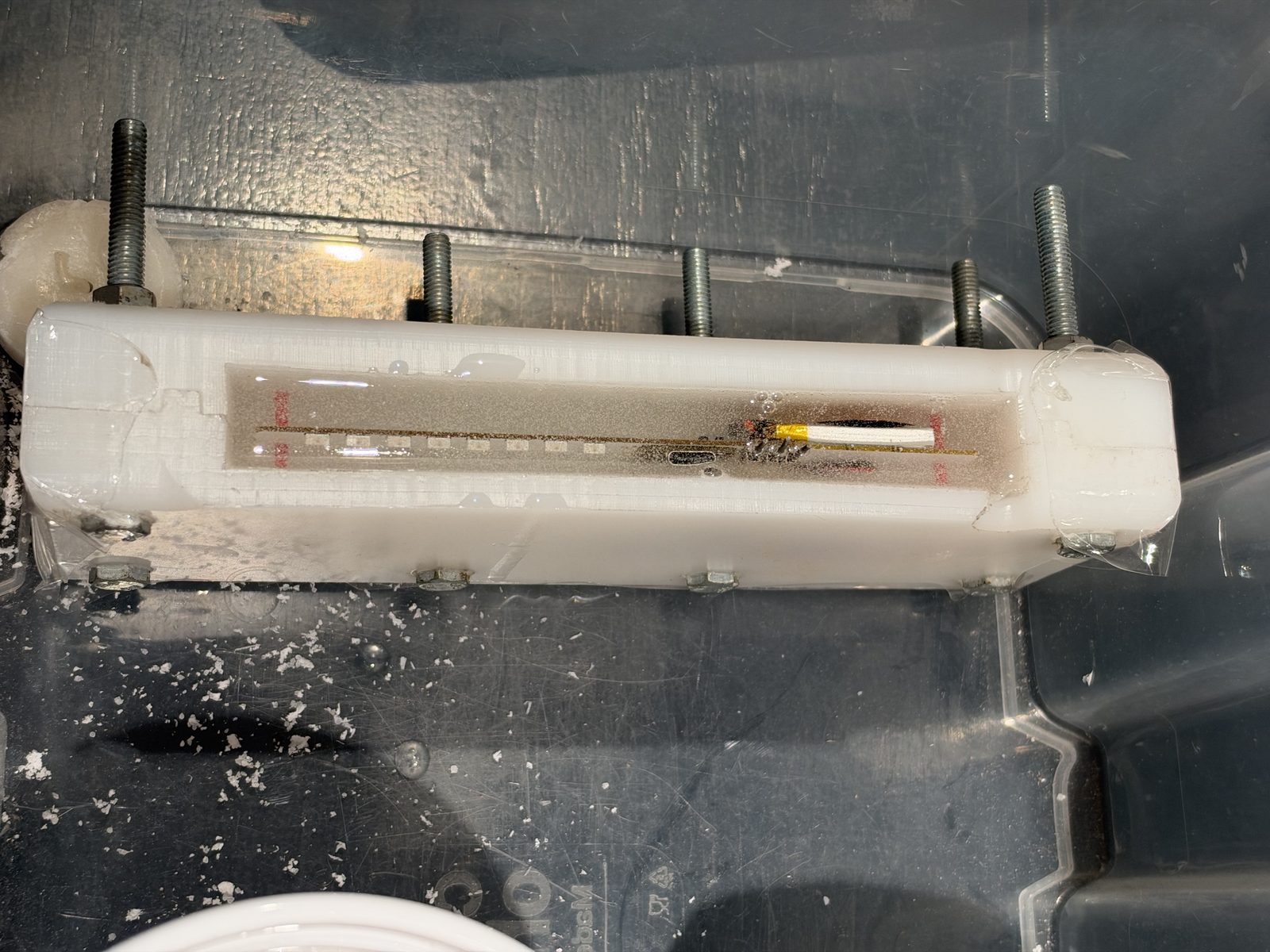
On the bench
The board running before casting, 17 November. These clips show the patterns as they were then; the Alarm has since been re-timed from the footage.
- 17 h 50 minon Glow at low brightness, one charge
- 5 h 50 minspinning at full brightness
- 3 hto charge, by USB or on a wireless pad
- 32LEDs, eight positions of four
250 m
Set up from the phone
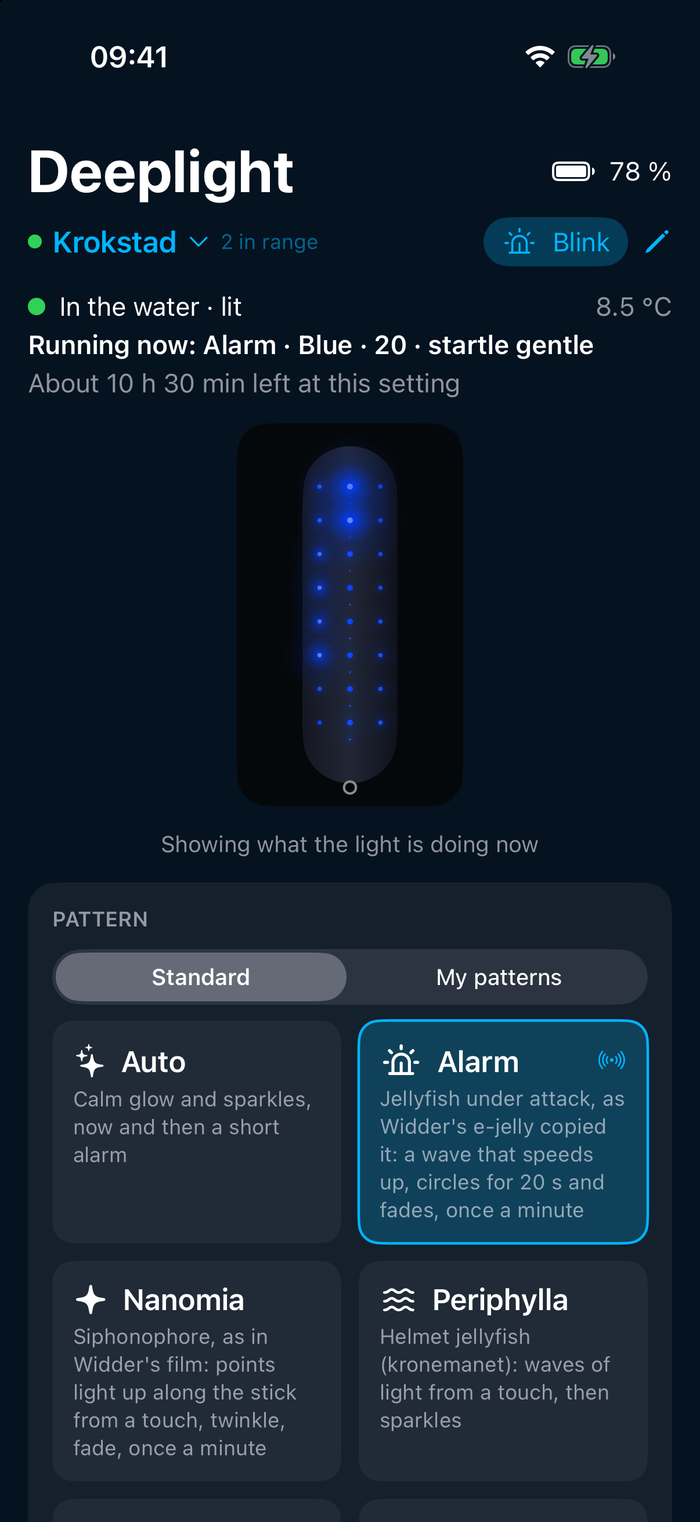
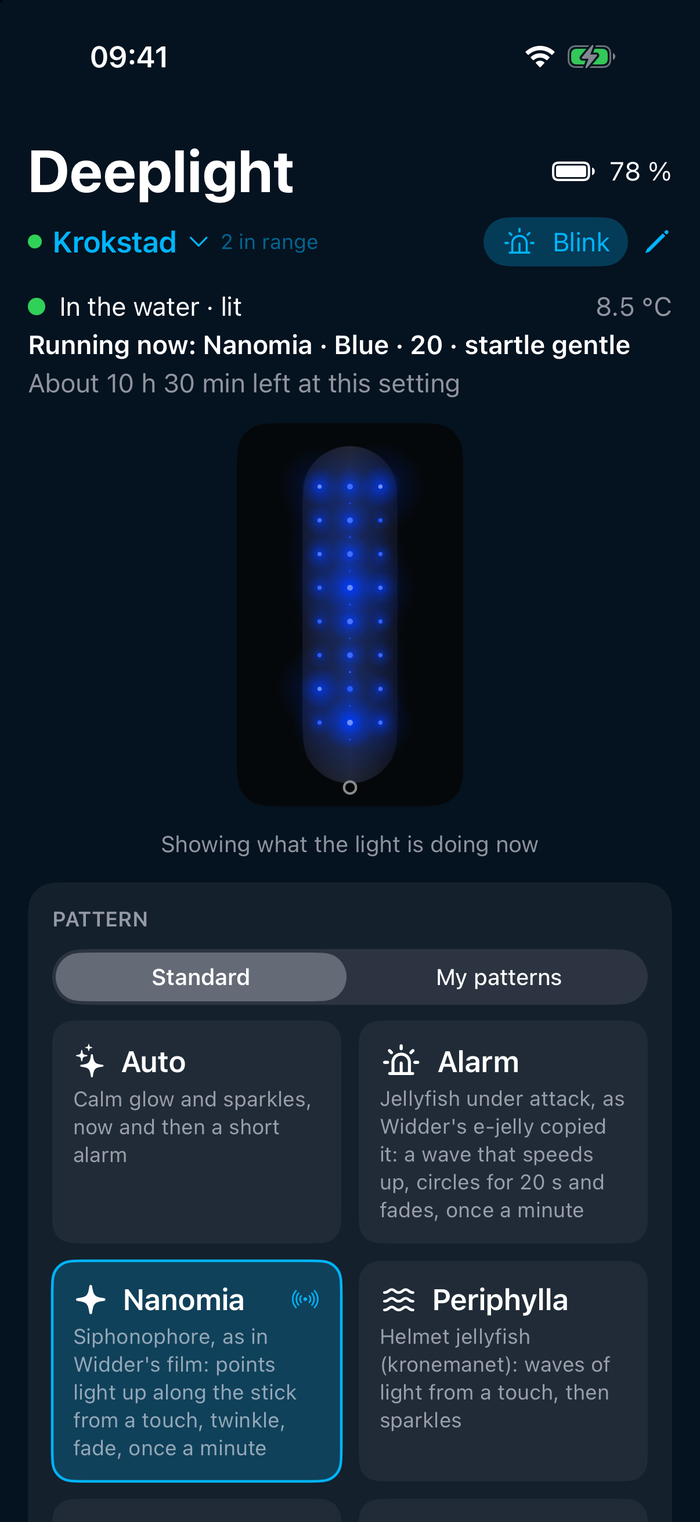
The app talks to the light over Bluetooth. Pick a pattern and it plays on the phone first, so you see what you are sending.
Brightness can follow depth, or the light sensor can set it in the water. Startle fires a burst when you jig. The app shows battery and how long the light will last at the current setting, and updates the light’s software over Bluetooth.
Three colours, each with a reason: blue, the colour the animals themselves make (465–470 nm); cyan, what deep fish see best and what carries furthest in fjord water; green, the colour most catch trials have used.
300 m
Test log
Newest first. New entries as the tests happen.
- Next
Bench tests through the epoxy: wireless charging, Bluetooth and software updates. Then a pressure test to 300 m, about 31 bar. Then the fjord, with a lit and an unlit rod side by side.
Alarm re-timed from the NOAA footage. New pattern: Nanomia.
Mould cut on the CNC. The first stick cast in clear epoxy.
First software update sent to a light from the phone, over Bluetooth.
Battery runs to empty: 17 h 50 min on Glow at low brightness, 5 h 50 min on Pinwheel at full. About 3 hours to charge, by cable or wireless pad.
The first three boards running.
First light: a 24-LED ring on the desk runs all ten patterns.
Parts ordered: ten small orders, about NOK 1,240.
The research behind it
The patterns stand on other people’s work. Deeplight is a hobby project; the researchers and organisations listed here are not involved in it.
- Herring, P. J. & Widder, E. A. (2004). Bioluminescence of deep-sea coronate medusae (Cnidaria: Scyphozoa). Marine Biology 146, 39–51. doi:10.1007/s00227-004-1430-7
- Widder, E. A. (2007). Sly eye for the shy guy: peering into the depths with new sensors. Oceanography 20(4), 46–51. PDF
- Widder, E. A. (2013). The Kraken revealed: the technology behind the first video recordings of live giant squid. Sea Technology 54.
- Robinson, N. J. et al. (2021). Studying the swift, smart, and shy: unobtrusive camera-platforms for observing large deep-sea squid. Deep-Sea Research Part I 172, 103538. doi:10.1016/j.dsr.2021.103538
- NOAA Ocean Explorer (2005). Operation Deep Scope: Atolla wyvillei burglar alarm display, video courtesy of E. Widder. Archived page
- Frank, T., Widder, E. & Haddock, S. (1997). Nanomia bioluminescence, video. UCSB Bioluminescence Web Page. Movies
- Bassot, J.-M. et al. (1978). Bioluminescence and other responses spread by epithelial conduction in the siphonophore Hippopodius. Biological Bulletin 155, 473–498. doi:10.2307/1540785
- Haddock, S. H. D., Moline, M. A. & Case, J. F. (2010). Bioluminescence in the sea. Annual Review of Marine Science 2, 443–493. doi:10.1146/annurev-marine-120308-081028
- Knutsen, T. et al. (2018). Coincident mass occurrence of gelatinous zooplankton in northern Norway. Frontiers in Marine Science 5, 158. doi:10.3389/fmars.2018.00158
- Animal Diversity Web. Periphylla periphylla. Species account
- University of Bergen (2023). Photophores of Maurolicus muelleri in Masfjorden and Fensfjorden. Article